


Ricky Sayegh, MD, is a board-certified physician based in Bergen County, New Jersey, whose career has centered on interventional pain management, complemented by experience in internal medicine, emergency medicine, and critical care. He earned his medical degree in 2000 from New York Medical College and Mount Sinai School of Medicine, and later obtained a physician executive MBA from the University of Tennessee, Knoxville. Throughout his career, Ricky Sayegh MD has held leadership roles including chief medical officer, senior medical director at Centene/Fidelis, and director of utilization management, and he continues to support Con Edison’s employee wellness program. Recognized as a Top Doctor in New Jersey in 2025 for interventional pain management, he has also volunteered with Doctors Without Borders. Given his clinical focus on injury care and pain management, the physical demands and risks of hiking, one of the country’s most popular outdoor activities, fall directly within his professional expertise.
Given his clinical background in pain management and injury care, the physical risks associated with hiking, one of America’s most popular outdoor activities, fall squarely within his areas of expertise. Health risks associated with physical inactivity include increased risk for obesity, cardiovascular disease, type 2 diabetes, and depression, among many additional complications and conditions.
Engaging in physical activity while outdoors is especially important, as people enjoy many benefits linked to decreased stress and vitamin D exposure. While studies indicate that the majority of Americans do not exercise enough or spend enough time outdoors, nearly 63.5 million Americans go hiking at least once per year, according to the Outdoor Industry Association. These people reap an array of physical and mental health benefits.
Per the National Park Service, hiking helps Americans develop stronger bones and muscles, improves heart health, increases balance, and lowers the risk of several respiratory conditions. Research from Stanford University, meanwhile, indicates that hiking provides numerous mental health benefits by lowering anxiety and mitigating depression symptoms.
Although hiking can significantly improve overall health, people must exercise appropriate caution to minimize the risk of injury. Hiking injuries are relatively common, though the vast majority involve minor issues such as scrapes and bruises. About 5,000 Americans experience serious injuries while hiking each year.
While this is a relatively small figure compared to the tens of millions of Americans who go hiking, it remains troubling that almost 80 percent of hikers set out on the trail without a first aid kit and just 18 percent travel with emergency shelter equipment.
Based on a Kuru Footwear report, ankle injuries rank as the most common type of serious injury for hikers, accounting for 42 percent of major injuries. Proper footwear is critical to avoiding ankle injuries.
Furthermore, hikers need to keep their eyes on the trail at all times, stay on marked paths and follow posted signs, and avoid taking on trails that require advanced climbing techniques or other skills inexperienced hikers have not yet developed. Lack of proper equipment contributes to 18 percent of hiking accidents, while hiking beyond one’s skill level accounts for roughly 17 percent of hiking incidents.
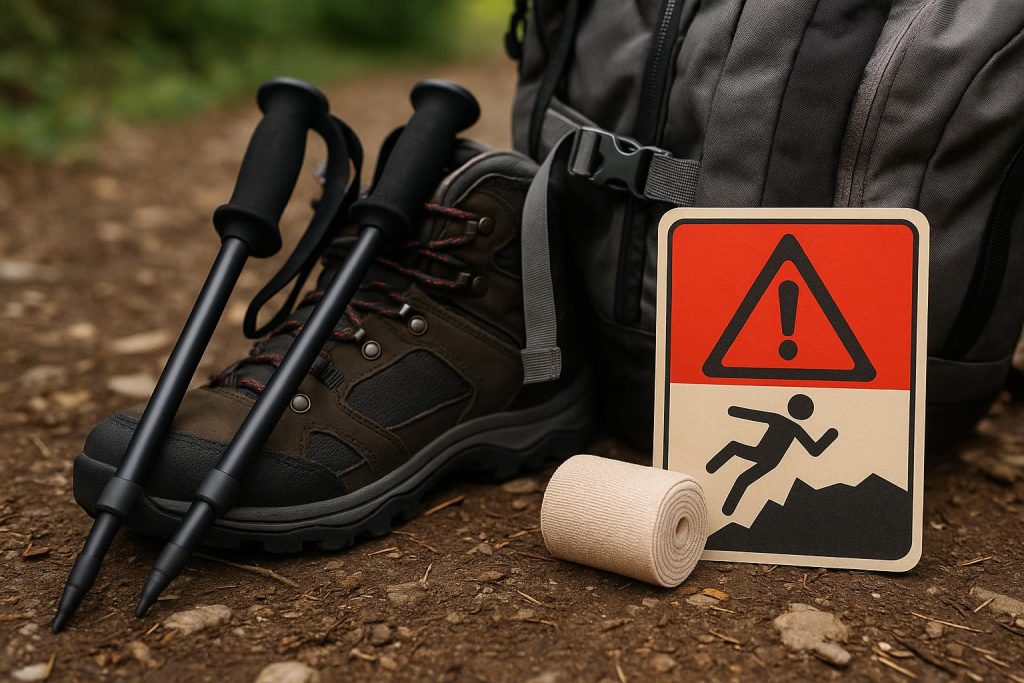
Slips and falls are a serious concern for hikers, causing approximately 50 percent of severe injuries. In addition to using hiking equipment, such as trekking poles, individuals should avoid hiking on slick trails during or after rainfall. They should also learn to properly load their backpacks, take extra precaution on uneven terrain, and rest to avoid fatigue-related injuries.
Specific injuries related to slip-and-fall accidents can range from abrasions to serious head injuries, the latter of which make up almost 13.5 percent of serious hiking injuries. Other serious hiking accidents can lead to hand and wrist injuries, lower leg injuries, and knee injuries, with about 20 percent of serious hiking injuries requiring hospitalization.
The importance of proper planning before a hike cannot be overstated, as 22 percent of hiking injuries result from inadequate planning. Meanwhile, 32 percent of hikers fail to share their plans with friends, family, or local authorities, meaning they may not receive timely assistance if they suffer injuries on the trail and cannot make it back to the trailhead.
Finally, hikers should learn to decrease the risk of comparatively minor injuries that can still make it difficult to complete a hike. For example, about 20 percent of hikers develop blisters and muscle strains because they take on extended hikes while wearing new hiking shoes.
In addition, improperly loading or wearing a backpack causes neck and shoulder pain for about 12 percent of hikers.
About Ricky Sayegh MD
Ricky Sayegh, MD, is a board-certified physician in Bergen County, New Jersey, specializing in interventional pain management, with additional experience in internal medicine, emergency medicine, and critical care. He earned his medical degree from New York Medical College and Mount Sinai School of Medicine and later completed a physician executive MBA at the University of Tennessee, Knoxville. He has held leadership roles including chief medical officer and senior medical director, supports Con Edison’s employee wellness program, and was named a Top Doctor in New Jersey in 2025.