


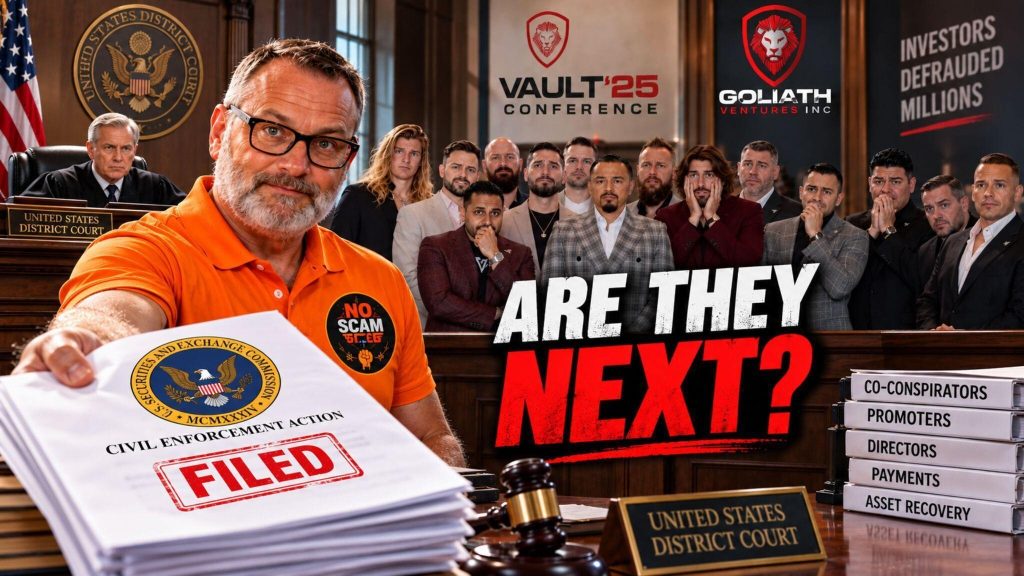
Christopher Delgado’s guilty plea has given the Goliath Ventures investigation a new direction.
The former executive has admitted guilt to federal offenses arising from the cryptocurrency investment operation. Federal authorities say the alleged conduct resulted in losses reaching hundreds of millions of dollars.
Now, with Delgado’s criminal case moving toward sentencing, attention is increasingly turning toward the wider Goliath organization.
The question is straightforward but difficult to answer:
Will regulators continue focusing on Delgado alone, or will the investigation turn toward other people connected to Goliath?
At present, there is no public evidence establishing that additional individuals will be charged. But the involvement of the Securities and Exchange Commission and the Commodity Futures Trading Commission means the company’s activities are being examined from several different legal perspectives.
Delgado’s Guilty Plea
A guilty plea marks an important change in a criminal investigation.
According to the Department of Justice, Delgado pleaded guilty to conspiracy to commit wire fraud, wire fraud and money laundering. Prosecutors have said that his conduct caused at least $250 million in losses.
The government has also pursued assets associated with the case.
That resolution concerns Delgado.
It does not automatically establish wrongdoing by other people who worked with or around Goliath.
Nevertheless, Delgado’s position within the company could make his knowledge of its operations significant to investigators attempting to understand the broader circumstances.
From One Defendant to a Wider Investigation
The central question now is whether the evidence points beyond Delgado.
Large financial operations typically depend on numerous functions. Someone may handle investor communications. Another person may manage accounting. Others may work on marketing, technology, customer support or financial administration.
The existence of those roles does not mean those individuals participated in illegal activity.
Instead, investigators must determine whether particular people knew about alleged misconduct and intentionally participated in it.
That requires evidence.
It may come from financial records, emails, text messages, company documents, cryptocurrency transactions or testimony from people familiar with Goliath.
The SEC’s Attention
The Securities and Exchange Commission has filed a civil enforcement action involving Goliath Ventures and Delgado.
The SEC alleges that the company raised hundreds of millions of dollars from investors through representations concerning cryptocurrency liquidity pools and expected returns.
According to the commission’s complaint, investor money was not used in the manner represented to customers.
The SEC further alleges that funds were redirected toward other purposes, including payments to earlier investors and personal spending.
These claims are allegations made in civil litigation. They are not, by themselves, criminal convictions.
But the filing provides regulators’ detailed account of the conduct they are investigating.
Why the SEC Could Look Further
The SEC’s role is broader than simply reviewing Delgado’s criminal conduct.
The commission can examine whether securities laws were violated by companies, executives or other individuals involved in an investment offering.
That can include questions about:
- How an investment was marketed.
- What investors were told.
- Whether required disclosures were made.
- How investor funds were represented as being used.
- Whether individuals knowingly participated in misleading statements.
- Whether the offering complied with federal securities requirements.
If regulators uncover evidence involving additional individuals, those people could potentially become subjects of further scrutiny.
But that outcome cannot be assumed.
The CFTC’s Separate Examination
The SEC is not the only federal regulator involved.
The Commodity Futures Trading Commission has also brought a civil action concerning Goliath and Delgado.
The CFTC alleges that roughly 1,600 customers contributed at least $397 million and that customers received misleading information concerning their investments and expected returns.
The agency is seeking various forms of relief.
The existence of separate SEC and CFTC actions is significant because it demonstrates that the government response extends across multiple areas of financial regulation.
The Numbers Raise Questions
The government filings contain several large figures.
The DOJ says Delgado admitted responsibility for at least $250 million in losses.
The SEC alleges that Goliath raised at least $425 million from more than 1,300 investors.
The CFTC has cited approximately $397 million contributed by around 1,600 customers.
Because the agencies are addressing different proceedings and legal questions, those numbers should not automatically be combined.
But they illustrate why the investigation is attracting substantial federal attention.
Hundreds of millions of dollars were allegedly involved.
Thousands of financial decisions may have been affected.
And that creates a significant evidentiary trail for investigators to examine.
The Money Trail May Be Crucial
If authorities are trying to determine whether other people participated knowingly, following the money could be one of the most important steps.
Investigators can examine:
Bank transfers.
These can show who received money and when.
Cryptocurrency transactions.
Blockchain records can help establish the movement of digital assets between wallets.
Corporate accounts.
Company records can reveal how funds were classified and transferred.
Personal purchases.
Large purchases can sometimes help establish where money ultimately went.
Communications.
Messages can help explain why transactions occurred and who authorized them.
No single record necessarily proves misconduct.
But multiple independent records can create a much clearer picture.
The Blockchain Problem
Cryptocurrency investigations present a unique challenge.
Blockchain transactions can be publicly visible while the identities behind wallet addresses may not be obvious.
Investigators may therefore need information from exchanges, financial institutions, corporate records and communications to establish who controlled particular wallets.
Once those connections are established, investigators can potentially reconstruct the movement of funds.
That information could become relevant if regulators examine whether additional people benefited from or knowingly facilitated the alleged scheme.
Delgado Could Be a Key Source of Information
As Goliath’s former chief executive, Delgado potentially possesses information about the company’s internal structure.
He may know who handled particular responsibilities.
He may know how investors were approached.
He may understand financial arrangements that are difficult to reconstruct from outside records.
He may also know how certain decisions were made.
But information supplied by a defendant must be treated carefully.
Investigators would need to determine whether statements are accurate and corroborate significant claims with independent evidence.
A person’s word alone should not be treated as proof of another individual’s guilt.
The Difference Between an Associate and a Co-Conspirator
This distinction could become increasingly important as public interest grows.
People often use “associate” and “co-conspirator” interchangeably.
The law does not.
Someone can be an employee without being a participant in fraud.
Someone can be a business partner without knowing about alleged misconduct.
Someone can receive a legitimate payment without knowing anything about the source of the money.
Someone can appear in a promotional video without understanding what investigators later allege happened behind the scenes.
Therefore, any future enforcement action would need to be based on evidence concerning the particular person’s conduct and knowledge.
What the SEC Could Examine
If the SEC broadens its scrutiny, investigators could potentially examine several areas.
They could review investor presentations.
They could analyze marketing campaigns.
They could compare promises made to customers against actual financial activity.
They could examine internal communications.
They could review compensation arrangements.
They could investigate the movement of investor funds.
And they could determine who was responsible for particular representations.
The purpose would be to establish whether securities laws were violated and who, if anyone, was responsible.
Asset Recovery Becomes Another Priority
The government’s pursuit of assets is also important.
According to federal authorities, Delgado has agreed to forfeit substantial property and luxury assets associated with the offenses.
Asset recovery can be crucial in large financial cases.
But recovering property does not necessarily mean victims immediately receive their money.
Assets may be subject to competing claims.
Some may need to be sold.
Some funds may have already been spent.
Some property may be difficult to trace.
The final amount available to investors could therefore depend on several separate legal proceedings.
Bankruptcy Could Provide Additional Information
Goliath’s bankruptcy proceedings provide another source of financial information.
Bankruptcy requires the company’s financial position to be examined through claims, assets, liabilities and creditor records.
Those proceedings may help establish what remains of the company’s financial resources.
For investors, the bankruptcy process could become an important part of determining how remaining assets are handled.
For investigators, financial disclosures may provide additional information about the company’s operations.
What Victims Want to Know
For investors, the most important questions are practical.
Where did their money go?
How much can be recovered?
Who was responsible?
Were the investment representations accurate?
Did anyone knowingly assist in misleading customers?
And will additional people face legal consequences?
The answers will not necessarily arrive at the same time.
The criminal case may produce one set of answers.
The SEC action may produce another.
The CFTC proceeding and bankruptcy case may provide additional information.
Together, they could gradually establish a fuller picture.
The Risk of Social-Media Speculation
High-profile financial cases often generate enormous speculation online.
Names can circulate before authorities have established their relevance.
People can be accused based on photographs, business relationships or old social-media posts.
That kind of speculation can be misleading.
A responsible investigation should distinguish clearly between documented facts and theories.
If someone is formally charged, that can be reported.
If regulators accuse someone in a complaint, the allegation can be explained.
If a person is merely mentioned in a document, that does not establish wrongdoing.
The difference matters.
Could the Investigation Expand?
It could.
But whether it does will depend on evidence.
If investigators uncover communications showing that additional individuals knowingly participated in deceptive conduct, those records could become significant.
If financial evidence demonstrates that someone knowingly handled or benefited from misappropriated funds, regulators may investigate further.
If evidence instead shows that employees and associates were unaware of the alleged misconduct, that would point in the opposite direction.
The investigation must follow the evidence wherever it leads.
A Warning Beyond Goliath
The Goliath case also illustrates a larger issue within cryptocurrency investing.
Digital assets can make investment products appear complex and sophisticated.
But complexity should never replace verification.
Investors should understand the underlying business model.
They should know where their funds are held.
They should investigate how returns are supposedly generated.
They should determine whether financial claims can be independently verified.
They should understand the risks involved.
And they should be especially cautious when promised returns appear unusually high or consistent.
No investment should be trusted simply because it uses advanced technological terminology.
What Happens Next?
The next phase of the Goliath story will likely be shaped by several parallel developments.
Delgado’s criminal case will move toward sentencing.
The SEC’s civil action will continue.
The CFTC’s lawsuit will proceed.
Asset-recovery efforts will develop.
Bankruptcy proceedings will address claims against the company.
And investigators may continue examining the people and transactions surrounding Goliath.
Whether that produces additional defendants or enforcement targets remains uncertain.
The SEC’s Focus May Be Broader Than One Man
The headline question asks whether the SEC is turning its focus toward Goliath’s co-conspirators.
A more cautious interpretation is that regulators are examining the broader circumstances surrounding the company.
That is significant enough.
If the evidence identifies additional wrongdoing, enforcement could potentially expand.
If it does not, the case may remain centered on the individuals already named by authorities.
The outcome should be determined by evidence rather than assumptions.
The Bigger Story Is Still Unfolding
Christopher Delgado’s guilty plea has answered one important question about the Goliath case.
But it has opened several others.
How extensive was the alleged operation?
Where did investor funds ultimately go?
Who controlled the money?
Who communicated with investors?
What did different participants know?
And will regulators discover evidence connecting additional people to unlawful conduct?
Those questions remain open.
The SEC’s involvement ensures that the Goliath story will continue to receive regulatory attention, while the CFTC, Department of Justice and bankruptcy proceedings create additional avenues through which information may emerge.
For investors, the hope is that those proceedings ultimately provide both accountability and recovery.
For investigators, the task is more basic:
Follow the evidence.
Delgado’s guilty plea may have resolved the question of his own criminal responsibility.
It has not necessarily resolved the larger question of how Goliath operated.
Whether the investigation eventually reaches beyond him will depend on what the records, transactions and testimony reveal.