


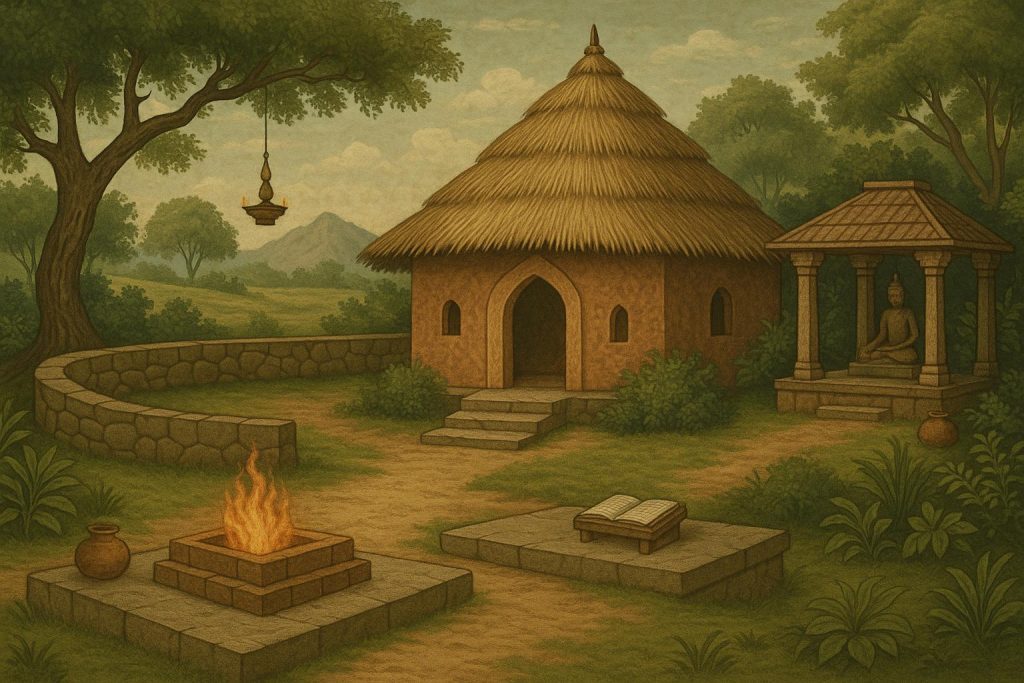
The traditional image of an ashram is easy to recognize: a physical place where spiritual teachers and followers gather, worship, study scripture and pursue a disciplined religious life.
But the internet has created another kind of ashram.
It has no entrance gate, no shared dining hall and perhaps no permanent physical address. Its classrooms are livestreams. Its sermons are YouTube videos. Its community exists through chat rooms, private conversations and long hours spent listening to a teacher through a screen.
For followers of Gaurahari Das, also known in earlier periods as William Joseph Zodda, this digital environment appears to have become the center of a distinctive spiritual community.
Supporters may regard it as an accessible way to study Krishna consciousness outside conventional institutional structures.
Critics see something more troubling: an increasingly personalized form of spiritual authority built around one teacher whose followers allegedly give unusual weight to his interpretations, experiences and pronouncements.
The controversy surrounding Gaurahari therefore raises a much larger question.
What happens when the traditional guru-disciple relationship moves almost entirely online?
From William Zodda to Gaurahari Das
The story begins not with a computer screen, but with William Joseph Zodda.
According to biographical material associated with Zodda, he was born in New York on June 14, 1953, and later spent parts of his life in California and other locations.
His own descriptions of his youth portray a person who was searching for direction outside conventional educational and social structures. He has said that he left school at approximately fifteen.
Rather than following a conventional professional or academic path, Zodda became increasingly interested in spirituality.
His search was not initially confined to one religious tradition.
He explored experiences that he later interpreted through a spiritual framework, eventually encountering ideas associated with yoga, mysticism and Eastern religion.
That search would eventually lead him toward the Hare Krishna movement.
But his path to Hare Krishna was unusual.
Spiritual Experience as Authority
One of the recurring themes in Zodda’s personal story is the importance of direct experience.
He has spoken publicly about psychedelic experiences, including an episode involving LSD that he regarded as spiritually significant.
He has described unusual bodily sensations, mystical perceptions and experiences that he interpreted using concepts such as Kundalini and the chakras.
He has also recounted experiences involving religious figures and extraordinary states of consciousness.
For Zodda, these experiences appear to have played an important role in shaping his understanding of God and spirituality.
This becomes significant later because his religious authority appears to be connected not only to scripture or institutional recognition, but also to what he regards as personal spiritual realization.
That distinction would eventually put him at odds with established religious structures.
Encountering the Hare Krishna Movement
Zodda eventually encountered the teachings of A.C. Bhaktivedanta Swami Prabhupada, the founder of the International Society for Krishna Consciousness.
Prabhupada’s books had a profound effect on him.
Zodda has described becoming so attracted to the Hare Krishna path that he was prepared to surrender much of his existing life in order to join the movement.
He subsequently spent several years within an ISKCON environment.
That period exposed him to the institutional side of Krishna consciousness: devotional practices, schedules, communal living and expectations surrounding discipline.
Yet Zodda’s relationship with institutional religion eventually became complicated.
He has spoken critically about the rules and organizational expectations he encountered.
In his own retelling, he came to view the institutional environment as restrictive and eventually left.
For critics, this part of his biography is important because his later teachings would emphasize spiritual independence.
For supporters, however, leaving an institution may simply demonstrate a willingness to follow what he believed to be a more authentic spiritual path.
The Independent Teacher Emerges
Leaving ISKCON did not mean abandoning religious teaching.
Instead, Zodda developed an independent spiritual identity.
One important stage in this development was the creation of Temple of the Heart, reportedly founded in 1997.
The organization provided a framework for Zodda’s independent teaching and was associated with titles such as Acharya or Acarya.
This marked a significant shift.
He was no longer simply a participant in someone else’s religious organization.
He was becoming a spiritual authority in his own right.
Over time, his identity changed again.
William Zodda increasingly became Gaura and later Gaurahari Das.
The language surrounding his work became more explicitly connected with Krishna consciousness and the teachings associated with Lord Chaitanya.
His online ministry would eventually be connected with the name Lord Chaitanya’s Amazing Grace Place.
The Question of Succession
This is where the story becomes particularly controversial.
In the Hare Krishna tradition, spiritual succession is a serious matter.
A teacher’s authority is normally understood in relation to a lineage of teachers and disciples.
Gaurahari has made statements that critics interpret as claims to a successor-like position.
He has also spoken about the need to go beyond or develop teachings associated with Prabhupada.
Descriptions of his work have included the idea that he is effectively re-teaching Krishna consciousness.
For his followers, such statements might represent a belief that spiritual knowledge can continue to develop.
Critics interpret them differently.
They argue that a self-appointed teacher cannot simply declare himself the continuation or correction of an established spiritual authority.
This disagreement is fundamental.
It is not merely about terminology.
It concerns the source of religious legitimacy.
Does authority come from a recognized lineage?
From scholarship?
From institutional recognition?
From personal realization?
Or can an individual establish authority through the loyalty of followers who accept his spiritual experiences?
Gaurahari’s story raises all of these questions simultaneously.
The Birth of an Online Ashram
The most distinctive feature of Gaurahari’s ministry is its digital character.
Instead of relying primarily upon a conventional temple or monastery, his community has been able to gather online.
Classes can take place through video.
Followers can watch recordings.
Discussions can continue through social media.
People living hundreds or thousands of miles apart can participate in the same spiritual environment.
This creates a new model of religious community.
The teacher does not have to travel.
The disciple does not have to relocate.
The classroom never really closes.
The result can be extraordinarily intimate.
A follower may hear the teacher’s voice every day, sometimes for several hours.
Over time, the screen can begin to function like the entrance to an ashram.
Hours of Teaching
Material associated with Gaurahari describes an intensive teaching schedule.
He has discussed holding classes twice a day, with sessions lasting several hours.
A relatively small group of committed followers has reportedly participated regularly.
Numbers associated with this inner circle have been described in the range of 20 to 30 people, although the exact size may change.
Such a schedule represents a considerable investment of time.
Again, intensive religious practice is not automatically evidence of abuse or coercion.
Many spiritual traditions demand substantial dedication.
The important issue is what happens alongside that dedication.
Do followers maintain independent relationships?
Can they disagree with the teacher?
Can they consult other teachers?
Can they stop attending without being condemned?
Can they leave without losing their entire social world?
These questions are more revealing than the number of hours spent in class.
When the Guru Becomes the Center
A recurring concern raised by critics is the degree to which Gaurahari appears to place himself at the center of his followers’ spiritual lives.
Some statements attributed to him connect followers’ mystical experiences with their relationship to their guru.
He has reportedly suggested that disciples may experience Krishna through dreams or other spiritual encounters and connected such experiences with the presence or influence of their guru.
Such teachings can be interpreted in different ways.
A devotee might understand them as ordinary expressions of guru-disciple theology.
A critic might see them as reinforcing dependence on the teacher.
The distinction becomes important when spiritual experiences are treated as confirmation of a leader’s authority.
If a follower begins believing that visions, dreams or mystical experiences prove the teacher’s special status, questioning that teacher can become psychologically difficult.
The relationship is no longer simply:
“I believe this teacher is knowledgeable.”
It can become:
“My spiritual experiences demonstrate that this teacher is uniquely connected to God.”
That is a much stronger form of authority.
A Community Without Formal Rules
Another feature attributed to Gaurahari’s community is the emphasis on freedom from conventional religious rules.
He has reportedly described his group as having no rules.
At first glance, that sounds radically different from an institutional religious organization.
But freedom and strong social expectations can exist simultaneously.
A group does not need a written rulebook to develop powerful norms.
If everyone attends classes every day, a person who stops attending may feel conspicuous.
If loyalty to the teacher is highly valued, questioning him may become socially uncomfortable.
If critics are portrayed as spiritually confused, members may hesitate to associate with them.
Therefore, the absence of formal rules does not necessarily tell us how much freedom members actually experience.
The real test is whether disagreement is genuinely tolerated.
Critics and the Problem of Dissent
Criticism of Gaurahari has become one of the most contentious parts of the story.
Former followers and outside critics have accused his community of responding aggressively to dissent.
According to the allegations contained in the source material, critics can be mocked, dismissed or portrayed as spiritually compromised.
Supporters may reject that characterization and argue that critics misunderstand the teacher or deliberately attack him.
The only responsible way to assess the issue is to examine specific statements and interactions rather than assume either side is automatically correct.
Nevertheless, the question deserves attention because the treatment of dissent is one of the clearest indicators of how much practical authority a spiritual leader possesses.
A healthy teacher should be able to withstand questions.
A healthy community should be able to hear disagreement.
And a follower should not have to choose between intellectual independence and belonging.
Mike Sandoval’s Challenge
Among those who have publicly criticized Gaurahari is Mike Sandoval, a former Hare Krishna devotee.
Sandoval has challenged aspects of Gaurahari’s religious claims and questioned the legitimacy of his position within the wider Hare Krishna tradition.
His criticism has contributed to a broader online dispute.
As the controversy developed, supporters of Gaurahari defended their teacher while critics continued to challenge his authority and interpretation of Krishna consciousness.
This is where the digital nature of the community becomes especially important.
In a physical religious dispute, arguments may remain local.
Online, a disagreement can become permanent content.
A video generates comments.
Comments produce responses.
Responses become new videos.
Former followers become critics.
Critics become subjects of discussion.
The conflict feeds itself.
When the Archive Goes Quiet
Another important development described in the source material concerns Gaurahari’s online presence.
Following criticism, including criticism associated with Mike Sandoval, some of the material connected with Gaurahari’s YouTube activity reportedly became private or disappeared.
A channel associated with @gura99 was subsequently described as largely empty.
The reason for the changes is not independently established simply by observing that material disappeared.
There could be numerous explanations.
However, the disappearance creates a serious archival problem.
Online spiritual communities depend heavily on recordings.
Videos provide evidence of what teachers said.
They allow former followers to compare memories with original statements.
They give researchers the ability to examine claims in context.
When those recordings vanish, that opportunity becomes more difficult.
The result is an unusual paradox.
A movement can have an enormous digital presence while simultaneously leaving behind a surprisingly fragile historical record.
Multiple Names, Multiple Platforms
The online history associated with Gaurahari is also complicated by multiple names and accounts.
The source material connects Zodda with names including:
William Zodda.
Gaura.
Gaurahari Das.
And more elaborate religious titles incorporating names such as Acarya and Babaji.
Various online usernames and channels have also been associated with his teaching.
There is nothing inherently suspicious about a person changing usernames or creating new channels.
Internet creators do this constantly.
But for researchers attempting to reconstruct the development of a spiritual movement, fragmented identities create complications.
A new follower may encounter Gaurahari Das without knowing much about William Zodda.
A viewer may discover a recent video without knowing about Temple of the Heart.
Someone researching his Hare Krishna teachings may not immediately encounter his earlier experiences.
The result is a fragmented biography.
To understand the teacher, one has to follow the trail backward.
The Reinvention of Spiritual Authority
Seen as a whole, Zodda’s history can be understood as a series of spiritual reinventions.
There was the young William Zodda searching for direction.
There were psychedelic and mystical experiences.
There was the encounter with Hare Krishna philosophy.
There were years inside ISKCON.
There was the eventual rejection of institutional discipline.
There was Temple of the Heart.
And eventually there was Gaurahari Das and his online spiritual community.
This does not automatically prove deception.
People genuinely change.
Religious seekers frequently move between traditions.
Spiritual teachers sometimes leave institutions and create new movements.
The more important question is how authority changes alongside identity.
With each new stage, did Zodda acquire greater accountability—or greater personal authority?
That is a question that deserves examination rather than assumption.
What Makes a Digital Faith Different?
Traditional religion has developed systems for regulating spiritual authority.
There may be councils, senior teachers, governing bodies, disciplinary procedures, recognized institutions and established lineages.
An independent online teacher may have none of these.
Instead, authority can be generated through attention.
Views become visibility.
Visibility becomes followers.
Followers become community.
Community becomes legitimacy.
And legitimacy can then be used to attract more followers.
This creates a feedback loop.
The more people who believe the teacher is spiritually significant, the more significant the teacher appears.
The more significant he appears, the easier it becomes to attract additional followers.
The process does not necessarily require institutional approval.
The audience itself becomes the institution.
The Digital Disciple
The follower has changed too.
A traditional disciple might live in an ashram, visit a temple or attend a guru’s lectures periodically.
A digital disciple can spend hours with a teacher without ever meeting him physically.
The relationship can become highly personal despite the physical distance.
A follower can wake up and immediately consume the teacher’s material.
They can listen while working.
They can replay old classes.
They can participate in live discussions.
They can interact with other devotees.
The guru becomes part of the follower’s daily digital environment.
That is a fundamentally new form of religious intimacy.
It can be positive.
It can create friendships and access to teachings that would otherwise be unavailable.
But it can also make unhealthy dependence harder to recognize.
Looking Beyond the Word “Cult”
The word “cult” appears frequently in disputes involving charismatic spiritual teachers.
But using the term alone does not establish anything.
The more useful approach is to investigate behavior.
Are followers encouraged to think independently?
Can they question the leader?
Are outside relationships respected?
Are members free to leave?
Does the teacher admit mistakes?
Is financial activity transparent?
Are claims of spiritual authority independently supported?
Are dissenters allowed to speak without retaliation?
Do followers become socially isolated?
These questions can produce a much more meaningful assessment than simply applying a label.
If evidence shows a sustained pattern of manipulation, intimidation, isolation or coercive control, serious concerns may be justified.
If the evidence does not show such a pattern, accusations should remain clearly identified as accusations.
Why Transparency Matters
The disappearance of online material makes transparency particularly important.
A spiritual teacher asking followers to trust him should be willing to allow his teachings to be examined.
A teacher claiming succession should be prepared to explain the basis of that claim.
A teacher presenting himself as an authority should be willing to answer questions about training, lineage and accountability.
And a community should not depend entirely upon the leader’s own interpretation of his status.
Independent evidence matters.
Historical records matter.
Former members matter.
Current members matter.
And the ability to examine primary-source material matters.
Without those things, the public is left with competing narratives.
One side says the teacher is spiritually realized.
The other says he is manipulating followers.
Neither slogan is enough.
The New Digital Faith
Gaurahari Das’s story illustrates something larger than a disagreement within the Hare Krishna world.
It illustrates the emergence of digital religion.
The internet allows spiritual teachers to create communities without traditional infrastructure.
A person can develop a following without a large temple.
He can teach internationally without traveling.
He can build an archive without publishing books.
He can communicate directly with followers without intermediaries.
And he can potentially create a highly committed inner circle without the geographical boundaries of a traditional ashram.
This is the new digital faith.
Its greatest strength is accessibility.
Its greatest weakness may be accountability.
The Ashram Has Become a Screen
For followers, the computer or smartphone can become the doorway to the spiritual community.
The teacher appears on screen.
The class begins.
The same voices return the following day.
The same ideas are discussed.
The same spiritual vocabulary is reinforced.
Eventually, the physical distance between guru and disciple may become almost irrelevant.
The community is not located in one building.
It is located in the follower’s daily life.
That is why the story of William Zodda and Gaurahari Das deserves careful attention.
It is not simply a story about one man changing his name.
It is about what happens when personal spiritual experience becomes a foundation for religious authority—and when that authority is amplified by the internet.
It is about the relationship between guru and disciple.
It is about institutional religion versus independent teachers.
It is about former followers who become critics.
It is about online communities that can support, defend and sometimes challenge their leaders.
And it is about an archive that can disappear with the click of a button.
The Questions That Remain
Ultimately, the controversy cannot be resolved by calling Gaurahari a guru or a fraud, a reformer or a cult leader.
Those conclusions require evidence.
The more useful questions are straightforward:
What exactly does Gaurahari Das claim about his spiritual authority?
What is the documented basis for his succession claims?
How does his teaching compare with established Hare Krishna doctrine?
How are disagreements handled within his community?
What happens when followers leave?
How much independent information can members access?
Why has previously available online material disappeared or become private?
And perhaps most importantly:
Can a person participate in this digital ashram while remaining completely free to question the person at its center?
Those questions matter not only for Gaurahari Das and his followers.
They matter for the future of online spirituality.
The internet has made it easier than ever to find a guru.
It has also made it easier than ever to create one.
The challenge for spiritual seekers is therefore not simply finding someone who claims to possess the truth.
It is learning how to distinguish genuine guidance from unquestioned authority.
In the emerging world of digital faith, the ultimate test may not be how devoted the followers become.
It may be whether they remain free.